SURVEY OF MEDICINAL PLANTS PROGRAMME
The Survey of Medicinal Plants Unit (SMPU), which is one of the pioneer components of RRIUM, Srinagar, has been engaged with the following Research activities:
Ethnobotanical exploration and Ethno-Pharmacological studies
The unit has been conducting ethnobotanical exploration in Jammu & Kashmir and its adjoining areas with an ultimate aim to identify the areas with maximum wealth of medicinal plants. During these Survey programmes, the Researchers of the Institute collect samples and specimens of medicinal plants especially those which are used in Unani System of Medicine and local folklore. The survey teams also conduct ethnopharmacological studies and collect folk information on the use of plants for the treatment of various diseases by different tribal communities of the areas surveyed. This type of Folk information has great potential for the drug development using reverse pharmacology. Such studies will also help to identify the substitutes for those crude drugs which are being imported at present. That will help in saving foreign exchange for the country.
The Survey of Medicinal Plants Unit has conducted many short and long-term ethnobotanical survey tours in 121 forest areas/villages falling under 23 forest divisions of Jammu & Kashmir and Ladakh so far. Most of the survey tours were conducted in Kashmir valley, followed by Sindh valley including the parts falling in new UT of Ladakh, and Jammu provinces. The main areas explored, so far include Lidder valley Forest Division, Jhelum valley Forest Division, Anantnag Forest Division, Shopian Forest Division, Baramulla Forest Division, Poonch Forest Division, Rajouri Forest Division, Kupwara Forest Division and some of the areas of Doda/Kishtwar. Apart from J&K and Ladakh the Unit has conducted survey tours in some parts of Himachal Pradesh and Odisha also. The first phase of survey programme (still under progress) has resulted in the collection of a large number of medicinal plants. The major portion of the collection has been identified and properly preserved in the Herbarium of the Unit, which presently houses more than 6000 herbarium specimens. About 2400 specimens are under process for accession. The ethnobotanical studies in various parts of the state have resulted in the collection of 791 folk claims so far. Most of these claims have been already published in the form of Monographs while rest are in the process of publication by CCRUM, New Delhi.
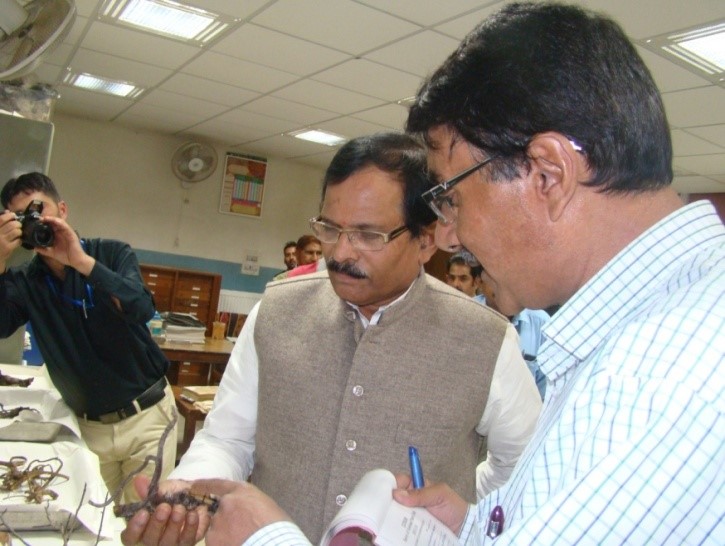
Hon’ble Minister of AYUSH in conversation with Research Officer (Botany)
Major Forest/Tribal Areas Covered During Survey
The major forest areas that have been surveyed so far fall in the forest divisions of Bandipora, Sindh Valley, Special forest Division Tangmarg, Srinagar, Anantnag, Lidder Valley and Jhelum Valley in the Kashmir Province of Jammu and Kashmir. In Chenab Valley some areas falling in Batote, Kishtwar and Baderwah forest divisions have been covered. From Jammu province some forest areas falling in forest divisions of Rajouri and Poonch have been surveyed. Kargil forest division which is now included in the Union Territory of Ladakh has been extensively explored right from Gumri up to Pensi la on one side and Batalik on the other side. Besides areas falling between Shargole and Sapi la and Batambis have also been explored. One special tour has been made to Kullu (HP).
The first phase of survey programme (under progress) has resulted in the collection of a large number of medicinal plants. The major portion of the collection has been identified and properly preserved in the Herbarium of the Unit, which presently houses more than 5900 herbarium specimens belonging to 638 species (accession completed up to 2015). The ethnobotanical studies in various parts of the state have resulted in the collection of 672 folk claims so far. Most of these claims have been already published in the form of Monographs while as, rest are in the process of publication by CCRUM Hqr’s, New Delhi.
The Unit is also involved is assisting the MD Scholars, Particularly, of Ilmul Advia (Pharmacology) in their research programme. This unit has also been rendering technical support regarding medicinal plants to other research, educational and skill development Institutes.
Museum for display of Crude Drugs
The Unit has developed a small but modest museum for display of crude drug samples in the Institute. At present it harbours 204 specimens of crude drugs. Most of these drugs have been collected during ethnobotanical explorations to various forest and tribal areas.
Cultivation of Unani medicinal plants on moderate scale.
The Survey of Medicinal Plants Unit is also engaged with the cultivation of Unani medicinal plants. Till date about 15 species which are widely used in Unani medicine were cultivated under this programme. The yield of these species (923 Kg) so far has been supplied to the Council and its peripheral Institutes particularly CRIUM Hyderabad, RRIUM, Chennai for the preparation of kit medicines and other research purposes. Apart from this the drug samples were also sent to others Research Institutes of the country like NIPER, NBRI, IIIM (CSIR) etc. Some drug samples were also sent to National Centre for Natural Products Research, School of Pharmacy and University of Mississippi USA.
Experimental Cultivation
(i) Introduction/Acclimatization of the Exotic and High Altitude Medicinal Plants
Under this activity, the introduction and acclimatization of exotic species, an important Unani drug Mucuna pruriens L. (Konch) was introduced for the first time in Kashmir. Its successful cultivation here under moist and cold climatic conditions is an achievement. It was recently followed by another Unani drug Gaozaban (Borago officinalis L.). Goazaban is native to Mediterranean region and was successfully cultivated here in the Institute. Two other exotic plants that have been introduced and cultivated at the Institute are Ammi majus L. (Atrilal) and Lavandula officinalis Chaix (Huzma). The preliminary trials have also been completed for Withania somnifera (L.) Dunal and North American species Echinacea purpurea L. which is considered as most potent immunomodilator. At present the Unit is engaged with the work on introduction and propagation of Aloe vera (L.) Burm. f.
Among the high altitude species some of the important plants that have been acclimatized or are still under experimental studies include Arnebia benthami, Inula racemosa, Artemisia maritima, Atropa acuminata, Paeonia emodii, Delphinium denudatum, Aconitium heterohyllum, Juniperus communis, Picrorhiza kurooa etc.
(ii) Development of Agro-Techniques
The agro-techniques of some plants have also been established. Through a series of experiments on the basis of comparative studies, a package of cultural practices like plant geometry, inter- and intra-row spacing, optimum fertilizer requirement, sowing and harvesting time, etc to improve the yield has been established for Lavandula officinalis Chaix, Hyoscyamus niger L, Ammi majus L, Datura stramonium L, Cichorium intybus L, etc.
(iii) Conservation of Rare and Threatened Medicinal Plants
The institute has been working continuously on the conservation/propagation of endangered, vulnerable, rare and threatened medicinal plants, particularly, those that are used in the Unani System of Medicine. In this regard a small part of the herbal garden has been established as Gene Bank to conserve the germplasm of rare and threatened medicinal plants, particularly that are already included in red lists of CITES or IUCN. The SMPU is continuously making efforts to develop protocol for conservation strategies of important rare, threatened and endangered medicinal plants. Some of the plants on which work has been conducted under this programme are Arnebia benthamii (Wall.ex G.Don) Johnston, (Goazaban), Saussurea costus (Falc.)
Lipsch. (Qust), Dactylorhiza hatagirea (D.Don) Soo (Salapmisri), Artemisia maritima L (Darhald), Delphinium denudatum Wall. ex Hook.f. & Thoms (Jadwar), Podophyllum hexandrum Royle (Wanwangun), Angelica glauca Edge (Chohr), etc. Those plants have also been taken up under this programme that are vulnerable because of their wide use and collection through wild crafting.
Medicinal Plant Nursery for Public Awareness
Under this activity about 52 medicinal plant species are continuously maintained in the medicinal plant nursery in pots, particularly, those used in Unani System of Medicine. Each plant is provided with the scientific and vernacular name of the plant and its uses for awareness and display purpose. Moreover, field lectures on the use of plants are delivered to the people who visit the site.
High altitude medicinal plant, Arnebia benthamii (Kahzaban) under experimental cultivation
Exotic medicinal plant, Borago officinalis L. (Goazaban) under experimental cultivation
Plant under experimental cultivation, Picrorhiza kurrooa (Kutki)
Cultivation under NMPB Project, Artemisia absinthium L. (Afsanteen)
Survey team at border village of Gurez near LOC
An important Unani medicinal plant, Saussurea costus (Qust)
Survey team collecting folk-claims at Handarman–Kargil
 Regional Research Institute of Unani Medicine